Back to blogFinance & Operations

The Month-End Close: A Step-By-Step Guide for Singapore SMEs
Late reports, missing documents and unresolved discrepancies can make every month-end more difficult than it needs to be. Learn how Singapore SMEs can build a clearer close process, catch errors earlier and gain faster visibility into business performance.
6 min read
For most finance teams, the final week of the month is not really finance work. It is chasing – bank statements, missing receipts, an accrual someone forgot, a spreadsheet that loves on one person’s laptop. The numbers eventually arrive, but the process that produced them is hard to repeat and harder to audit. This guide breaks the month-end close into eight stages that you can assign, measure and improve.
Why the Close Keeps Slipping?
A slow close is rarely caused by difficult accounting. It is caused by dependencies that nobody owns. One task cannot start until a bank feed refreshes; another waits on a colleague's approval; a third depends on a figure that is still being argued about in a chat thread. When those dependencies are invisible, the close becomes a series of interruptions rather than a sequence.
The common failure conditions are consistent across SMEs:
- Inputs arrive late and unevenly. Supplier invoices, expense claims and intercompany confirmations trickle in after the period has already been locked.
- Reconciliation is treated as a single step rather than a set of checks with their own owners and evidence.
- Judgement calls sit in people's heads. Accruals, prepayments and provisions get re-decided every month because the reasoning was never written down.
- The review happens at the end. Errors surface only when the management pack is assembled, which is the most expensive moment to find them.
- Nothing is measured. Without a baseline for hours and error rates, there is no way to tell whether a process change actually helped.
“A close is a coordination problem wearing an accounting costume. Fixing the process, the owners and the evidence usually recovers more time than buying a faster spreadsheet.”
That distinction matters because it determines the follow up actions to improve this process. If your bottleneck is data entry, software helps. If your bottleneck is a missing approval, software alone will not and you need a workflow with an accountable human element in it.
The Eight Stages of a Month-End Close
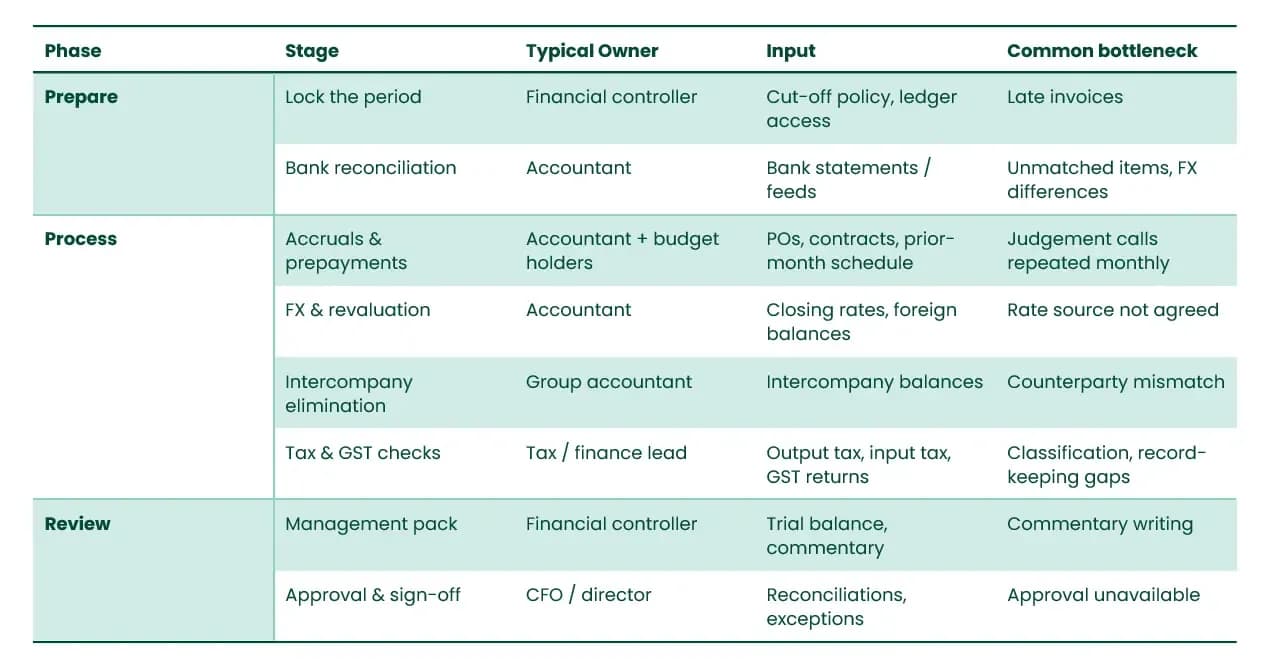
The table below groups the close into three phases – Prepare, Process, Review – and eight stages. It is designed to be generic deliberately as the labels are less important than the idea that every stage has an owner, an input and a definition of what is needed to be done.
Prepare: make the inputs predictable
Stages 1 – 2 are about cut-off discipline. A written cut-off policy — what can still be posted, by whom, and until when — removes most of the 'just one more invoice' drift. Cloud ledgers with automated bank feeds, such as Xero, reduce the manual collection work, but they do not replace the need for a clear cut-off rule. Singapore companies also have statutory filing obligations that sit alongside the management close; checkout ACRA’s financial statements filling requirements and exemptions to understand what must be lodged and when.
Process: turn judgement into a repeatable schedule
Stages 3 – 6 carry the accounting risk. The single highest-leverage change here is a standing schedule for accruals and prepayments: a list of recurring items, the logic behind each, and the evidence attached. Once that exists, the monthly task becomes 'confirm or amend' rather than 're-derive'. The presentation and disclosure baseline for the resulting statements is set out in SFRS(I)s, which is a useful anchor when deciding how much detail the pack needs.
Review: move the checking earlier
Stages 7 – 8 should be a confirmation, not an investigation. If reconciliations are signed off as each stage completes, the management pack is an assembly job.
How Much Time Does a Manual Close Take?
The table below illustrates a mid-market finance team across six recurring close activities. It contrasts a fully manual process with one where an AI is utilized in drafting reconciliation, schedule and commentary, and a human approves each change before it is committed.
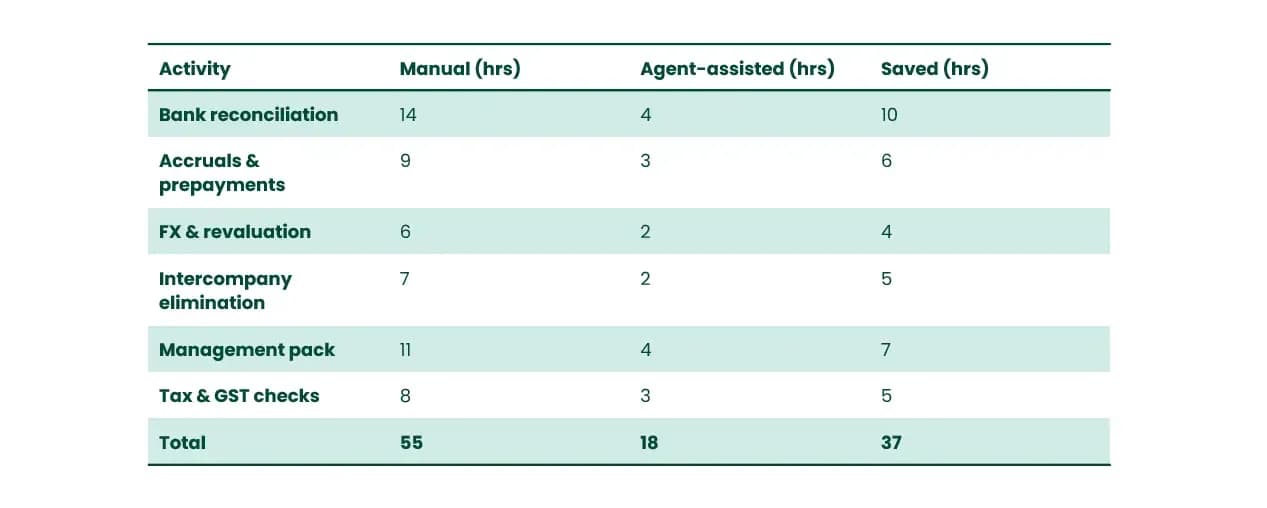
The hours are illustrated average based on a mid-market finance team, the average month-end close takes 8 to 10 business days (or roughly 6 to 8 calendar days depending on the reporting depth). Notice where the hours do not go to zero despite with artificial intelligence assistance. Reconciliation, tax treatment and sign-off still consume time because they require a person to accept responsibility. That is a feature of a well-designed process, not a limitation of the technology.
Where Automation Helps? Where It Doesn’t?
Good candidate for delegation:
- Data collection and matching. Pulling statements, matching transactions, flagging exceptions.
- Drafting recurring schedules. Proposed accruals, prepayments and depreciation from a standing logic.
- First-pass commentary. Variance descriptions against budget or prior month, ready for a human to edit.
- Checklist chasing. Tracking which inputs are missing and who owes them.
Keep a human in the loop:
- Anything that changes a financial record. A proposed journal is a proposal until someone approves it.
- Judgement on tax and classification. GST treatment, revenue recognition and provisions carry consequences that outlast the close.
- Exception resolution. An unmatched item is often a business problem, not a data problem.
- Final sign-off. Accountability for the numbers cannot be delegated to software.
These are some practical differences between an assistant that suggests and an agent that acts. For finance related workflow, the safest useful position is to let the agent draft while let the accountant decide.
SimpleAI’s NOVA workspace is built around exactly that boundary where it prepares work across accounting, tax and reporting, but every change requires human approval before it is committed to the records. Find out more about NOVA here.
Frequently Asked Questions
1. How long should a month-end close take?
There is no universal number — it depends on entity count, transaction volume and whether you have a group consolidation. Rather than chasing an external benchmark, time your own stages for one cycle and set a target for reducing the longest waits. Many SMEs find the biggest gains come from cut-off discipline and standing schedules, before any software is involved.
2. Which close tasks are safe to automate first?
Start with drafting and matching: bank reconciliation exceptions, recurring accrual schedules, and first-pass variance commentary. Keep approval, tax classification and final sign-off with a person. A useful rule is that the agent may prepare a proposal but may not commit a change to the ledger on its own.
3. Does a cloud accounting system fix a slow close?
It removes a lot of manual data collection, but it does not fix late inputs, unclear ownership or repeated judgement calls. Treat the ledger as one component of the process. The sequence, the owners and the evidence still have to be designed deliberately.
Share this article
Related Articles
Continue exploring more insights
 Insights
Why 'Good Enough' Bookkeeping Is Killing Your Growth (And What To Do Instead)
Many businesses settle for “good enough” bookkeeping until errors, compliance issues, and poor financial visibility start affecting growth. Learn the risks of manual bookkeeping and how automation can help you build cleaner books, better insights, and a stronger business.
SimpleAI
 Growth
How SimpleAI Transformed a Medical Clinic’s Bookkeeping- And What It Means for Your Business
Every business has unique processes, but most automation tools are built for the average use case. Learn how custom AI solutions can adapt to complex bookkeeping workflows, automate invoice processing, improve accuracy, and scale alongside your business.
SimpleAI
 Automation
Agentic AI: From Buzzword to the Quiet Team Member
Agentic AI is the next evolution of business automation. Unlike traditional software that waits for instructions, AI agents can observe, decide, and take action toward a goal. Discover how SimpleAI uses Agentic AI to streamline bookkeeping, accounting, and business operations.
SimpleAI