Back to blogBusiness & Growth

Business Grant vs Business Loan vs Investor: The True Cost of Capital
The cheapest-looking source of capital is not always the least expensive. Compare business grants, loans and investors to understand what your company gives up in funding, flexibility and control.
10 min read
Most of the comparison article on business funding eventually says the same thing: 'it depends on your situation.' That is true and unhelpful. The question is not whether it depends, but it is what it depends on, and how to weigh the factors against each other when the answer is not obvious.
This article aims to build a framework on the true cost of capital and applies it to the three common funding routes available to Singapore businesses government grants (like EDGE and Startup SG), business loans (including the Enterprise Financing Scheme), and equity investors (angels, VCs and government co-investment). The framework treats cost as more than the interest rate. It includes what you give up, such as ownership, control, future flexibility, and the time spent securing the funding itself. By the end, you should be able to look at your own situation and identify which route, or which combination can minimize your true cost.
Five Dimensions of The Cost of Capital
When you take money into your business, you pay for it. They payment is not always in cash, and it is not always visible. We explore the cost of capital through five dimensions:
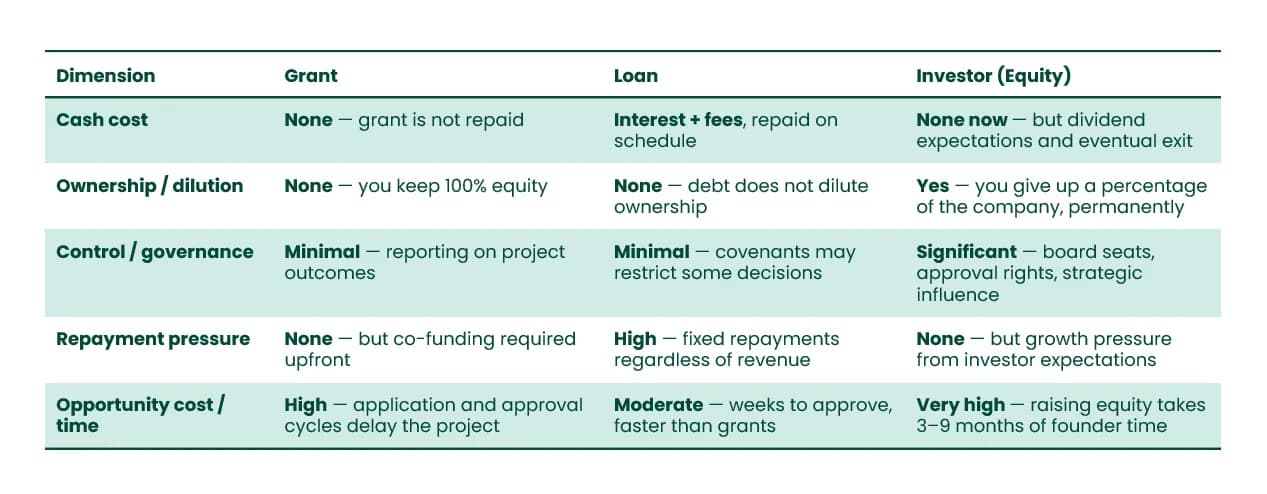
The insight from this table is that no single funding type is 'cheapest' across all five dimensions. A grant has zero cash cost and zero dilution — but the opportunity cost of waiting for approval can mean missing a market window. An investor brings no repayment pressure but permanently changes who owns and governs your company. A loan preserves ownership but creates a fixed obligation that can break a business if revenue dips. The right choice depends on which dimensions matter most for your situation right now.
When a Grant is The Right Answer
A grant is non-dilutive, non-repayable funding for a specific project. In Singapore, the primary open scheme is EDGE (which replaced EDG, MRA and PSG in October 2026 — see our article for the full breakdown). Grants are the lowest-cash-cost funding available, but they come with three constraints that determine when they are the right choice:
The project must be definable and bounded. Grants fund specific projects such as digitalization, capability upgrading, overseas expansion, instead of a general working capital. If your funding need is 'we need cash to cover payroll while we grow,' a grant is not the answer. If your need is 'we need to implement a new accounting system and the project costs S$40,000,' a grant may cover up to 50% of that.
You must be able to co-fund. EDGE covers up to 50% for SMEs; you fund the rest (or up to 70% for overseas expansion). If you cannot fund your share, the grant does not help; it accelerates a project you were going to do anyway instead of creating a project you cannot afford.
You can afford to wait. Grant approval cycles take weeks to months. If the opportunity is time-critical, such as a situation where a competitor is entering your market or a key client contract requires immediate capability investment; the opportunity cost of waiting can exceed the cash savings. In that case, a loan disbursed in weeks may be the better economics despite the interest cost.
When a Loan is The Right Answer
A business loan is repayable debt that preserves ownership. In Singapore, the government-backed Enterprise Financing Scheme (EFS) is the most accessible route for SMEs, with participating financial institutions offering working capital loans and project loans. For example: the EFS-SME Working Capital Loan provides up to S$500,000, and the government shares the loan risk with the participating institution — which was enhanced in 2026, with the risk-sharing ratio raised to 70% for a limited period (September 2026 to March 2027).
Beyond EFS, commercial banks offer term loans, overdrafts and trade financing. The key characteristic of all debt is the same: you repay on a fixed schedule regardless of revenue.
The decisive factor for a loan is your repayment capacity. A loan is the right answer when your business generates or will reliably generate enough cash flow to service the debt without straining operations. This is why early-stage startups with no revenue almost never use debt because there is no cash flow to repay it. Conversely, an established SME with stable revenue that needs to bridge a seasonal gap or fund a specific asset is a strong candidate for debt, because the repayment capacity exists and ownership is preserved.
When an Investor is The Right Answer
Equity investment means selling a portion of your company in exchange for capital. The money does not need to be repaid, and there is no interest; but the cost is ownership, control, and a permanent claim on future returns. In Singapore, equity routes range from angel investors and venture capital to the government's Startup SG Equity scheme, which co-invests alongside qualified private investors in startups and deep-tech companies.
The case for equity is strongest when three conditions align:
- The capital needed exceeds what debt can prudently support. A pre-revenue startup raising S$500,000 for product development cannot service a S$500,000 loan because there is no revenue. An investor accepts the risk because the return is equity upside, not interest. This is why early-stage companies rely on equity: it matches the risk profile of the business.
- The investor brings more than money. Good investors bring network, expertise, customer introductions and credibility. If the capital is the only thing an investor offers, the dilution cost is harder to justify since you are paying equity for cash that a loan might have provided more cheaply. The strategic value must be real and specific, not aspirational.
- You are building for an exit or a large raise. Equity investors expect a return — typically through an acquisition, IPO or secondary sale. If your goal is to build a profitable, owner-operated business that generates income indefinitely, equity is often the wrong instrument: you are selling a share of returns you intend to keep. If your goal is to build a company that will be acquired or go public, equity aligns the incentives.
The Decision Framework: Which Route(s) For you
Most businesses do not choose one funding type, they sequence them. The right answer depends on your stage, revenue, goal and the nature of the need. The framework below maps common situations to the route that minimizes the cost of capital:
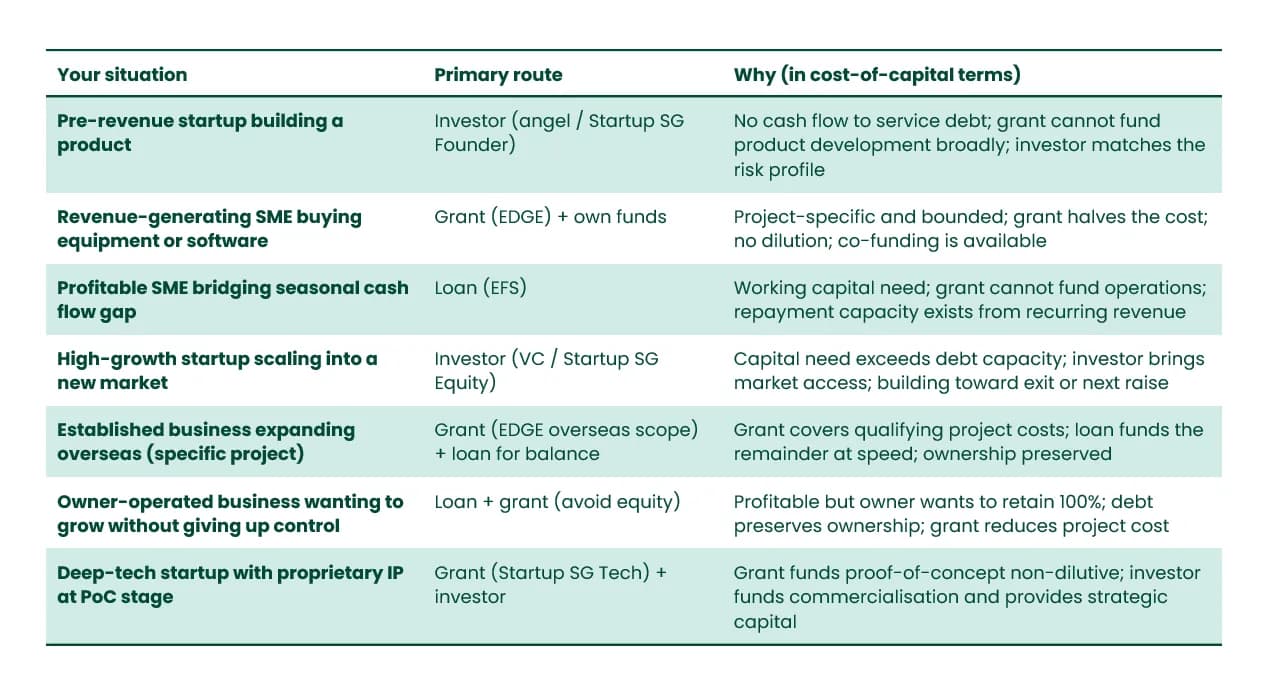
Notice the pattern: grants minimize cost when the need is specific and bounded; loans minimize cost when repayment capacity exists and ownership matters; investors minimize cost when the capital need exceeds what debt can support and strategic value accompanies the money. The framework is not about finding the 'best' funding type, it is about matching the cost structure of the funding to the risk and cash profile of the need.
The Hidden Cost Most Founders Underestimate
The cost that often catches founders or business owners off guard is not interest or dilution but the opportunity cost. The time and energy spent securing funding is the time that not spent selling, building, serving or generating value.
A founder who spends six months raising equity has paid an opportunity cost that does not appear on any term sheet. If those six months would have generated S$200,000 in revenue, the ‘free’ equity money cost S$200,000 in foregone growth. This is why you should never ask which funding is the cheapest; instead, ask which funding you can secure without halting the business. For a time-sensitive opportunity, a fast loan at 8% interest can be cheaper in true-cost terms than ‘free’ equity that takes nine months to close.
Should You Combine Routes? Or is One Enough?
The answer is usually not as straight-forward. A common and effective sequence:
Stage 1 — Startup SG Founder or angel investment to reach product-market fit. This is equity because there is no revenue to service debt and the need is broad (product development, early hiring), not project-specific enough for a grant.
Stage 2 — EDGE grant for specific capability projects (digitalization, process improvement) once the business is operating. The grant halves the cost of defined projects, and the business can now co-fund.
Stage 3 — EFS working capital loan or commercial loan to bridge cash flow during growth spurts. Now that revenue exists, debt becomes viable and preserves ownership.
Stage 4 — VC round or Startup SG Equity for scale-up capital, if the trajectory points toward an exit or a market the business cannot reach with internal cash flow alone.
Not every business uses all four. An owner-operated SME might use only stages 2 and 3 which is grant plus loan and never touch equity. Whereas a venture-backed startup might use stages 1 and 4 and skip grants entirely if the projects are not specific enough. By understanding your needs, you can plan your capital efficiently.
Summary Table
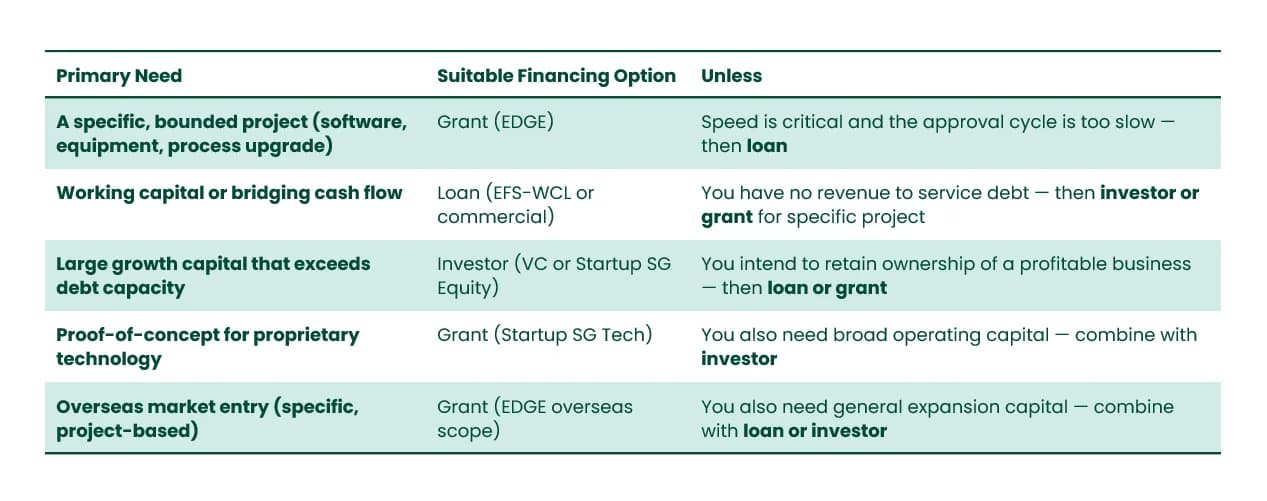
Here’s a summary table based on the potential capital financing needs:
Frequently Asked Questions
Is a grant always better than a loan because it does not need to be repaid?
Not always. A grant has zero cash cost, but it also has opportunity cost (the time spent applying and waiting) and a co-funding requirement. If the need is urgent working capital, a loan disbursed in weeks can be cheaper in true-cost terms than a grant that takes months and cannot fund operations immediately. The framework in this article discusses all five cost dimensions, instead of just cash cost.
Should I find an investor if I can get a loan instead?
It really depends. If a loan can fund the same need and your cash flow can service it, debt preserves ownership and is usually cheaper in true-cost terms. Equity makes sense when the capital need exceeds what debt can wholly support; when the investor brings strategic value beyond money; or when you are building toward an exit. If none of those apply, a loan is likely the better route.
Can I use a grant and a loan at the same time?
Yes, many growing businesses do, the two are not mutually exclusive.
What is the Enterprise Financing Scheme (EFS) and how is it different from a regular bank loan?
The EFS is a government-backed loan scheme administered by Enterprise Singapore through participating financial institutions. The government shares the loan risk with the lender, which can improve access and terms for SMEs that might not qualify for equivalent commercial loans.
How do I know if my cash flow can support a loan?
Calculate your debt service coverage ratio (DSCR): divide your free cash flow by the total loan repayment (principal plus interest) for the same period. A DSCR above 1.25–1.5 is generally considered healthy; below 1.0 means you cannot service the debt from current cash flow. This is usually the calculation lenders perform; by doing it yourself first with current financial records, it tells you whether a loan is viable before you apply.
Share this article
Related Articles
Continue exploring more insights
 Business & Growth
Singapore SME Grants by Business Type: A 2026 Match Guide
Not every grant fits every business. This 2026 guide helps Singapore SMEs match available support to their needs, from digitalization and productivity to capability development and overseas expansion.
SimpleAI
 Finance & Operations
The Hidden Cost of Manual Invoice Processing (Hint: It’s Not Labour)
Most business underestimate the true cost of manual invoice processing. Learn how approval delays, missed discounts, payment errors and poor visibility impact cash flow and growth.
SimpleAI
 AI & Agentic Transformation
Can AI Replace Accountants? The Wrong Question Businesses Should Be Asking
AI is unlikely to replace accountants, but it will replace much of the administrative work surrounding accounting. Learn how this shift could help finance professionals spend more time on analysis, judgement and business decisions.
SimpleAI