Back to blogBusiness & Growth

Singapore SME Grants by Business Type: A 2026 Match Guide
Not every grant fits every business. This 2026 guide helps Singapore SMEs match available support to their needs, from digitalization and productivity to capability development and overseas expansion.
9 min read
If you searched for Singapore SME grants and found a list that still mentions EDG, MRA and PSG as separate applications, that list is out of date. As of 30 September 2026, those three grants stopped accepting new applications. A single grant called EDGE — announced at the 2026 Committee of Supply debate by Senior Minister of State Low Yen Ling — replaced them through one unified shopfront.
This article does three things the other guides do not. First, it works from the current EDGE framework rather than the legacy grant structure. Second, it organizes grants by business type and stage as different type and size of businesses do not need the same advice. Third, it links every claim to the primary source so you can verify before you act, not after.
The October 2026 Shift: Three Grants Became One
Enterprise Singapore ran three flagship grants in parallel for years:
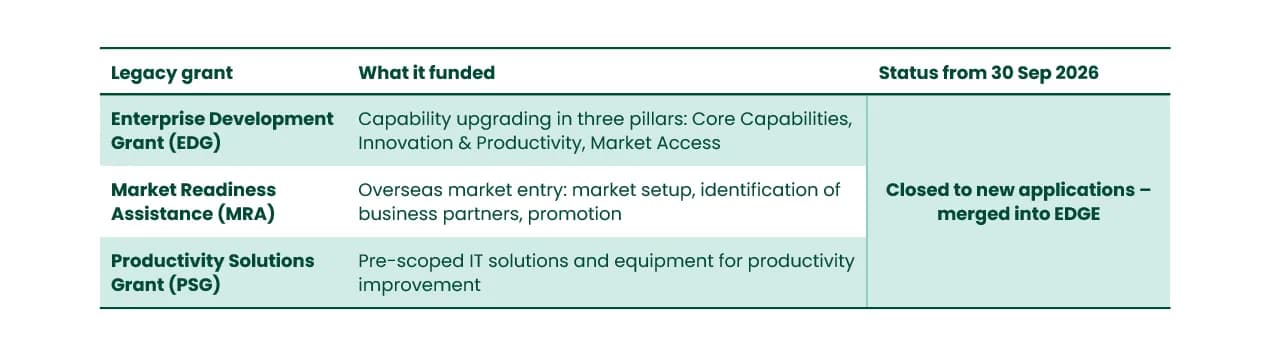
The merger is not cosmetic. The policy delivered at the MTI Committee of Supply debate was to simplify the application process by giving businesses a single-entry point rather than three separate portals with overlapping eligibility tests. For applicants, the practical change is this: you no longer need to figure out which of the three grants your project fits. The scope of what qualifies has broadened through the new EDGE grant which only required a single application.
Note: Existing approved projects under EDG, MRA and PSG continue their original terms. The merger affects new applications only.
Enterprise Development Grant (EDGE) Explained
EDGE consolidates the scope of its three predecessors into one application:
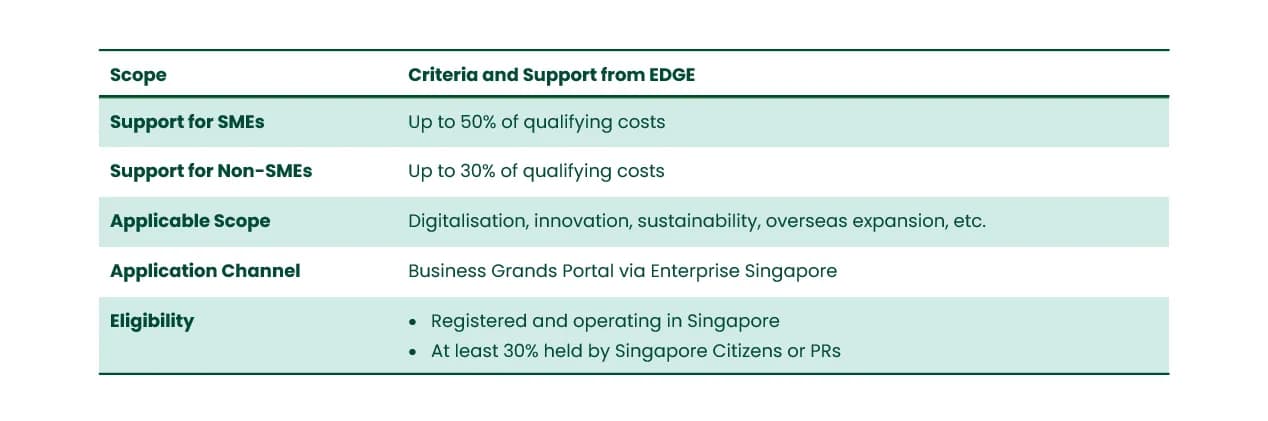
The 50% support rate for SMEs is the figure that matters for most readers. The remaining 50% is your co-funding where the grant does not cover, and you must be financially ready to complete the project before you apply. Enterprise Singapore and accredited grant consultants emphasize this point repeatedly: a grant is not a loan, and approval is contingent on your ability to fund your share.
Matching Grants to Your Business Type
This is where most grant guides go wrong. Most of them list every scheme and leave you to work out which one applies. But the right grant depends on what you are — a pre-revenue startup, a trading SME hitting growth ceilings, a digitalizing traditional business, or a company expanding overseas. The matrix below maps the current open schemes to business type and stage.
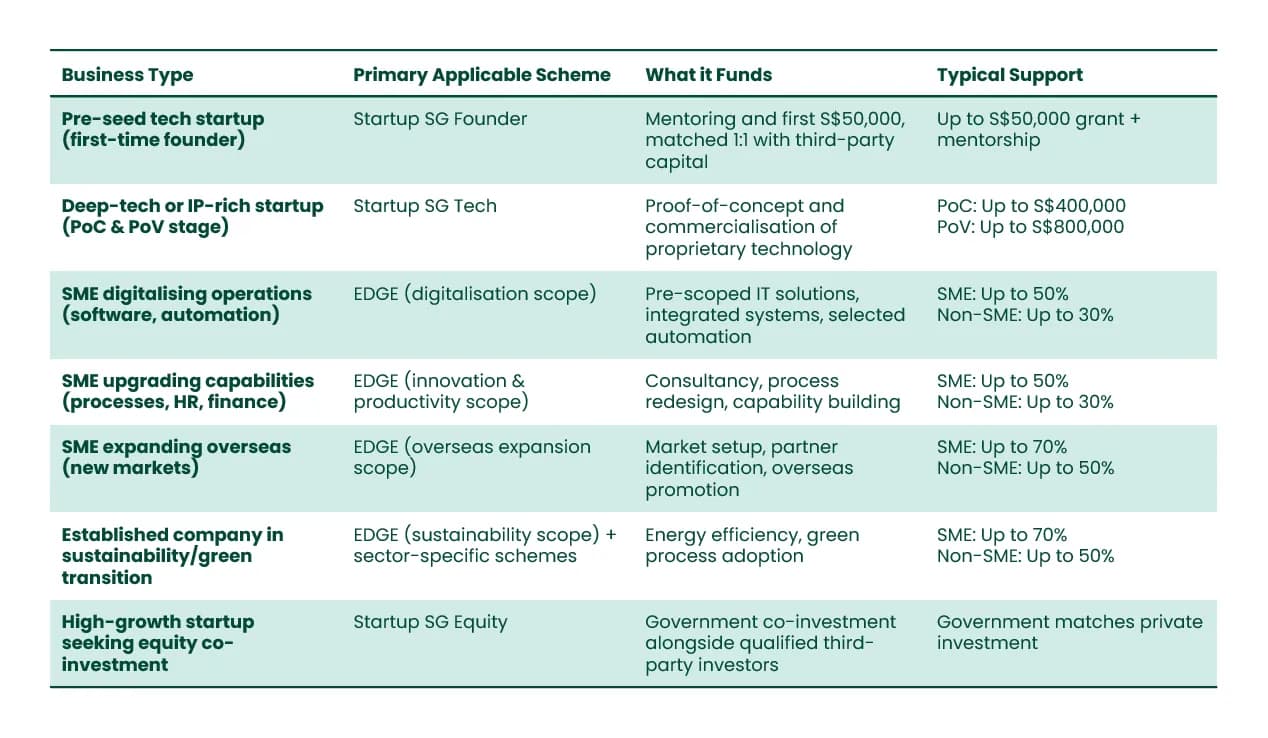
Most businesses qualify for more than one scheme over time — a startup might use Startup SG Founder at incorporation, EDGE for digitalization in year two, and Startup SG Equity when raising institutional capital. The question is not 'which grant do I get' but 'which grant fits the decision I am making right now'.
If You’re a First Time Founder or Pre-Revenue Startup
Singapore SG Founder is designed for you. It provides up to S$50,000 in grant funding, but the structure is what makes it different from EDGE: it is matched 1:1 by a third-party capital provider (an Accredited Mentor Partner), and it comes with mentorship, not just money. The eligibility test requires at least two Singapore Citizens or PRs as first-time founders, with the entity registered in Singapore and at least 51% local equity.
The match requirement is the gating factor. If you cannot raise the matching capital, the grant does not unlock. The scheme deliberately filters for founders who can attract at least some private conviction before public money follows.
If You’re a Tech Startup with Proprietary IP
Startup SG Tech operates at a different scale — up to S$800,000 for proof-of-concept and commercialization of proprietary technology. It is for projects where the technology itself is the asset: deep tech, med tech, advanced manufacturing, AI systems with defensible IP. The government also co-invests through Startup SG Equity for later-stage startups raising institutional rounds, matching qualified private investors.
Singapore's deep-tech ecosystem received a boost in 2026 with a S$440 million top-up to startup investment vehicles, as announced by EDB. If your startup is in a qualifying deep-tech sector, this expands the pool of co-investment capital available alongside Startup SG Equity.
If You’re an Operating SME Digitalising Your Business
This is the most common use case and the one most affected by the EDGE transition. Under the old PSG, businesses claimed support for pre-scoped IT solutions from a published catalogue. Under EDGE, the digitalization scope continues this function but within the broader single-grant framework. The support rate is up to 50% for SMEs.
Practical examples of what qualifies: HRMS and payroll software, accounting and bookkeeping systems (including GST-compliant and InvoiceNow-ready platforms), CRM systems, inventory management, and integrated enterprise systems. The annual cap structure for digital solutions reset on 1 April each year — so timing your application near the start of the financial year can matter if you are planning multiple technology purchases.
Note: If you are applying for EDGE to fund accounting or bookkeeping software, the system you choose should be GST-ready and InvoiceNow-capable from day one. Replacing non-compliant software mid-project is a common reason grant-funded digitalization projects stall. NOVA by SimpleAI handles GST/VAT rates, InvoiceNow e-invoicing, CPF-ready payroll and custom reporting in one platform — see the product page for the full module list.
If You’re Expanding Overseas
The former MRA is now the overseas-expansion scope within EDGE. It funds three activities that previously sat under MRA: setting up in an overseas market, identifying business partners, and overseas market promotion. The support rate for SMEs is up to 70%, subject to qualifying costs.
If your overseas expansion involves market entry in ASEAN, also check whether your project intersects with bilateral or regional support schemes administered through Enterprise Singapore's trade offices. These are narrower than EDGE but can complement it for specific markets.
How to Apply for EDGE
The Business Grants Portal is the single application channel for EDGE. The process is structurally the same regardless of your business type, though the documentation requirements vary by scope:
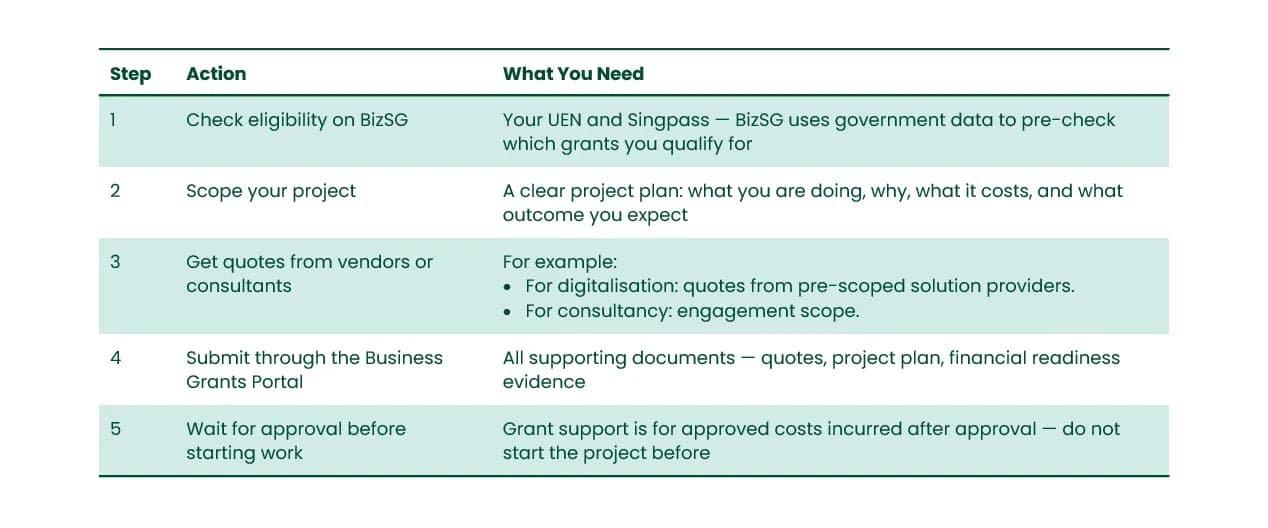
Note: Grant support applies only to costs incurred after approval. If you sign a vendor contract or start a project before your EDGE application is approved, those costs are not eligible. Plan your timing is essential in grant application.
Beyond EDGE, What is Available?
Beside of EDGE and Startup SG, several targeted schemes remain available for several purposes:
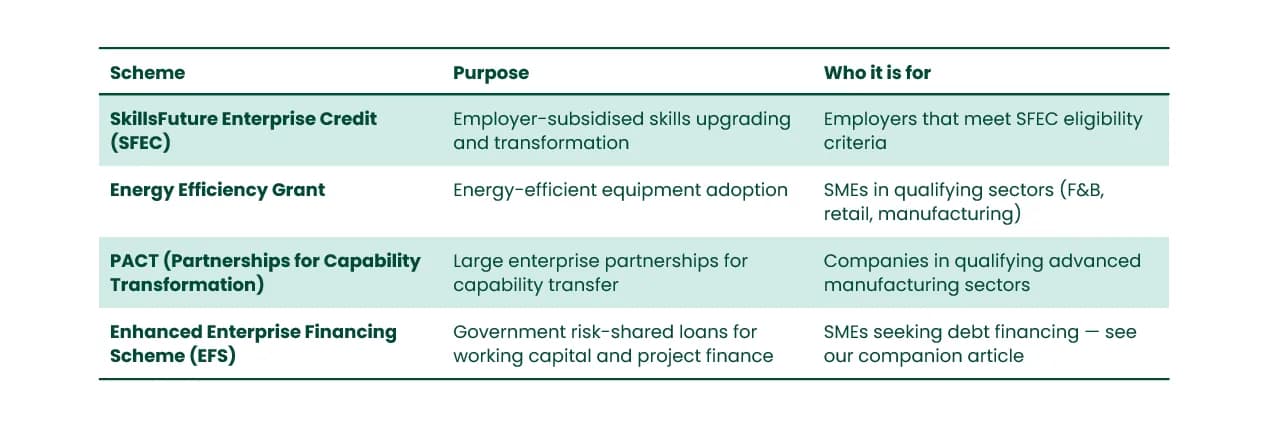
A growing business typically uses more than one over time, matching your needs can ease your application process. Find out the other ways to fund your business in another article where we discussed Business Grants vs Loan vs Investor and the true cost of capital.
Five Mistakes That Sink Grant Applications
Here are some patterns that grant consultants and Enterprise Singapore partners see repeatedly:
1. Starting the work before approval
What is it? Costs incurred pre-approval are not claimable.
How to avoid? Wait for the grant approval letter, build the project timeline around the approval date instead the other way around.
2. Vague project scope
What is it? Application is rejected or returned for revision, losing weeks and missing project timeline.
How to avoid? Write the project plan as if explaining it to a non-specialist, such as specific deliverables, cost and outcomes.
3. Choosing non-compliant software
What is it? Digitalization project stalls when the chosen tool cannot handle GST, InvoiceNow or local payroll.
How to avoid? Verify GST compliance, InvoiceNow readiness and CPF/payroll capability before selecting any funded software.
4. Underestimating co-funding
What is it? Project is approved but cannot be completed because the 50% self-funded portion was not budgeted.
How to avoid? Confirm the full project cost, make sure it is fully budgeted and available before applying.
5. Missing the BizSG pre-check
What is it? Eligibility is not fulfilled.
How to avoid? Use BizSG to run pre-check against what you’re qualified for.
Where Financial Management Meets Grant Reporting
A funded project creates a reporting obligation. Grant claims require evidence of qualifying costs such as vendor invoices, payment records, project milestones; and these records must be auditable. Businesses that run their books on spreadsheets often find that the reporting burden is the hidden cost of a grant, not the application itself.
This is where a structured financial platform earns its place. NOVA's Finance module handles AP/AR, expense tracking, bank reconciliation and custom reports, which means the records you need for a grant claim are the same records you maintain for your normal operations, not a separate parallel system. The approval workflows also mean every grant-related expenditure is reviewed and authorized before it is committed, which is the control standard grant bodies expect. See the NOVA solution page for the full capability list.
Start a Conversation
Every business operates differently. If you are exploring ways to improve your finance and operational workflows, implement AI practically or prepare your processes for growth, contact SimpleAI to discuss where redesign and automation could create meaningful value.
Frequently Asked Questions
Can I still apply for EDG, MRA or PSG?
No. As of 30 September 2026, EDG, MRA and PSG stopped accepting new applications. All three are now consolidated under EDGE, which you apply for through the Business Grants Portal. Existing approved projects under the legacy grants continue on their original terms.
What is the difference between EDGE and Startup SG?
EDGE is for operating businesses upgrading capabilities such as digitalization, innovation, sustainability, overseas expansion. Startup SG is for early-stage startups and includes Founder (first-time founders, matched funding), Tech (proof-of-concept for proprietary technology) and Equity (government co-investment). A business can use both at different stages.
Do I need a grant consultant to apply?
No, you can apply directly through the Business Grants Portal. However, for complex projects (especially EDGE applications involving consultancy and overseas expansion), accredited grant consultants can help scope the project correctly and avoid the common rejection reasons listed above. The cost of a consultant is not a qualifying cost under most schemes, confirm this before engaging one.
Are grants taxable income?
Government grants are generally taxable in Singapore unless specifically exempted. Confirm the tax treatment of your specific grant with IRAS or a tax adviser, as the treatment can vary by scheme and by how the funds are used.
Share this article
Related Articles
Continue exploring more insights
 Business & Growth
Business Grant vs Business Loan vs Investor: The True Cost of Capital
The cheapest-looking source of capital is not always the least expensive. Compare business grants, loans and investors to understand what your company gives up in funding, flexibility and control.
SimpleAI
 Finance & Operations
The Hidden Cost of Manual Invoice Processing (Hint: It’s Not Labour)
Most business underestimate the true cost of manual invoice processing. Learn how approval delays, missed discounts, payment errors and poor visibility impact cash flow and growth.
SimpleAI
 AI & Agentic Transformation
Can AI Replace Accountants? The Wrong Question Businesses Should Be Asking
AI is unlikely to replace accountants, but it will replace much of the administrative work surrounding accounting. Learn how this shift could help finance professionals spend more time on analysis, judgement and business decisions.
SimpleAI