Back to blogFinance & Operations

How the Three Financial Statements Connect? (And Why Profit Isn’t Cash)
A business can report rising profits while its cash balance continues to fall. Understanding how the three financial statements connect helps explain where the money went and whether the business is truly financially healthy.
6 min read
A profitable company can still run out of money, that single fact is why the three financial statements exist together rather than separately. Each one answers a different question, and the useful insight is almost always in the connections between them, hence, none of the statements should be read alone. This guide explains those links with an example for you to follow.
TL;DR: The One-Sentence Answer
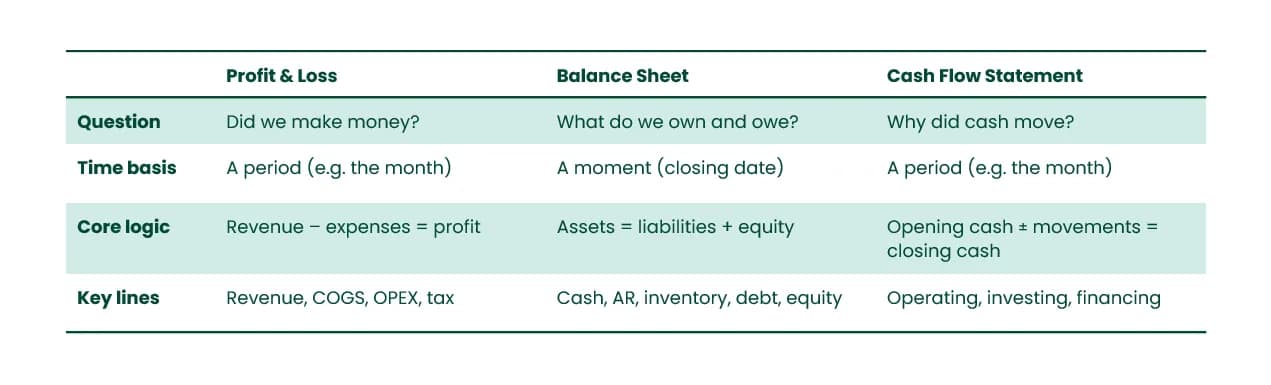
The profit and loss statement shows whether the business made money over a period. The balance sheet shows what it owns and owes at a point in time. The cash flow statement explains why the cash balance moved. Net profit from the first flows into retained earnings on the second, while the third reconciles the profit figure to actual cash. If those three links do not tie, something is wrong.
The Three Statements, Side-by-Side
In the early stages, many founders successfully manage basic financial administration themselves.
How the Three Statements Connect
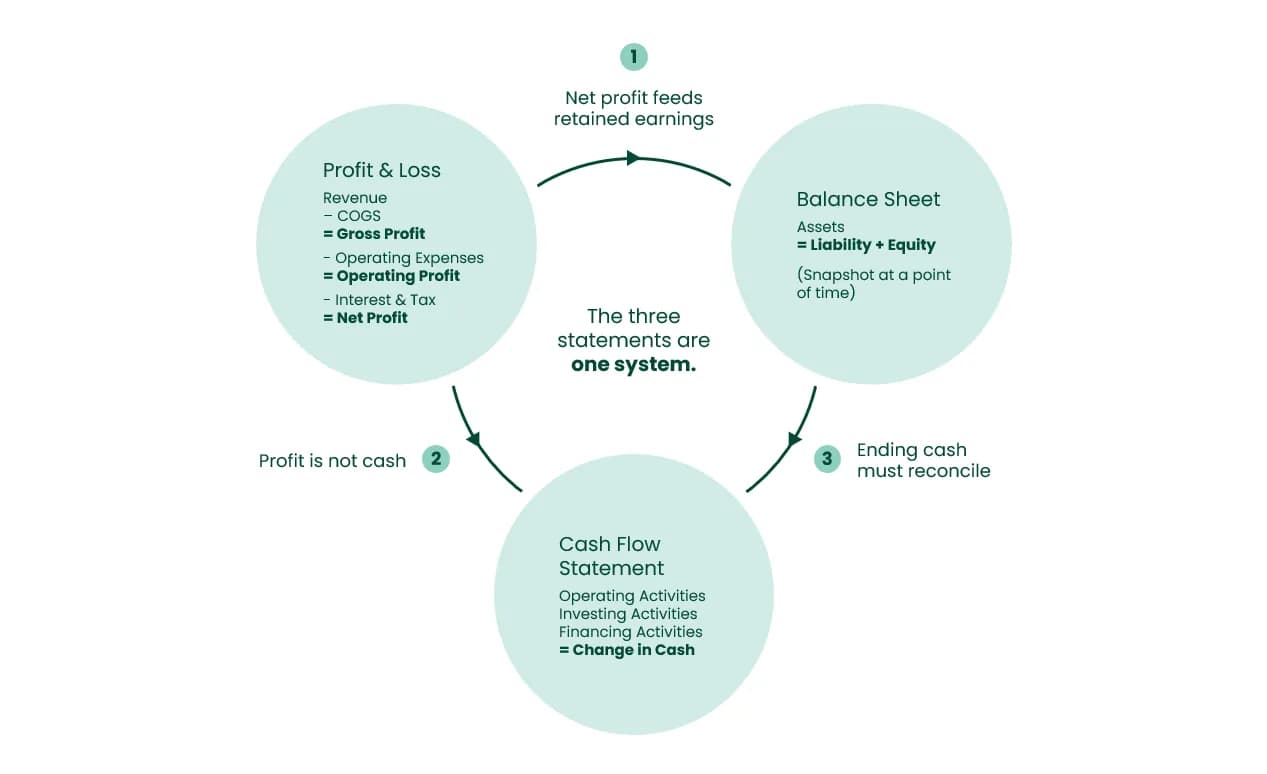
Link 1 – Net profit feeds retained earnings
At the end of the period, net profit (after tax and dividends) is added to retained earnings within equity on the balance sheet. This is the bridge between a period-based statement and a point-in-time statement. It is also why a loss reduces equity.
Link 2 – Profit is not cash
Revenue is recognized when it is earned, not when the customer pays. So, a S$100,000 invoice on a 30-days terms create profit and a receivable – but not cash yet. Depreciation reduces profit without any cash leaving. Inventory purchases consume cash before they touch the P&L as cost of sales. These timing differences are exactly what the cash flow statement reconciles.
Link 3 – Ending cash must reconcile
The cash flow statement starts with operating result, adjust for non-cash items and working-capital movements, then adds investing and financing flows. The final line must equal the cash and cash equivalents line on the balance sheet. If it does not, the error is usually in working capital or in a misclassified financing item.
An Example for Reading the Statements Together
Assume a trading company starts its first month with S$50,000 cash from shareholders. During the month it buys S$30,000 of inventory on credit, sells all of it for S$80,000 on 60-day terms, and pays S$12,000 of operating expense in cash. Ignore GST and tax for clarity.
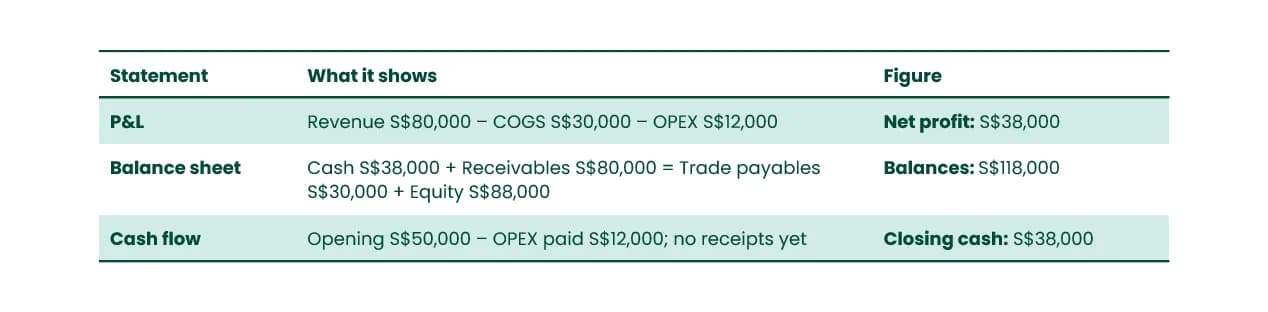
The business reports S$38,000 of profit on the P&L, yet its cash fell from S$50,000 to S$38,000. It has S$80,000 tied up in accounts receivable that has not yet been collected, while it still owes suppliers S$30,000. On paper it is profitable; in practice it must fund the working capital gap until customers pay.
Nothing here is an error. The risk appears only when you read one of them in isolation – which is why the connections matter more than the individual totals.
Why ‘Profit isn’t Cash’ Matters in Practice
The gap between profit and cash has a name: the cash conversion cycle. It adds the days customers take to pay and the days stock sits before sale, then subtracts the days you take to pay suppliers. The result is the number of days your cash is locked up in operations – a period during which a profitable business can still be short of money.
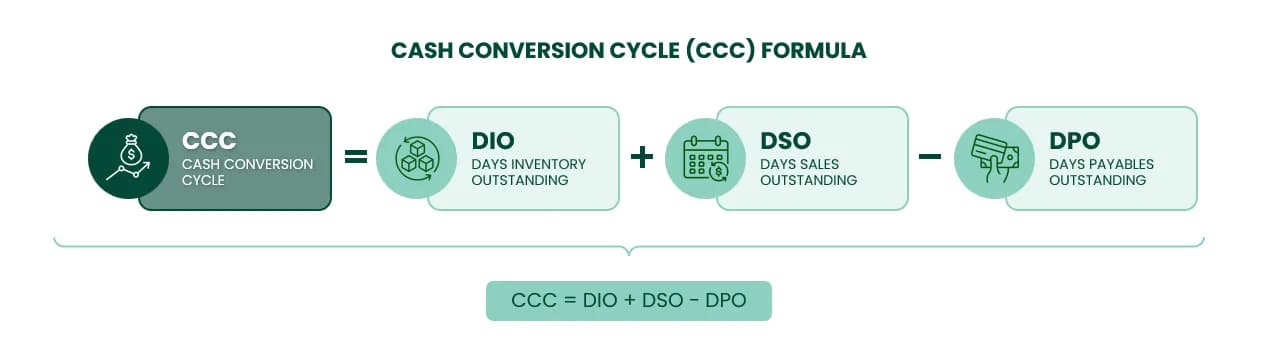
This is the arithmetic behind the worked example above. Shortening any one of the three components releases cash without changing the P&L at all, which is why working capital is an operating decision, not merely an accounting outcome.
- Growth consumes cash. Rising sales on credit terms can increase receivables faster than cash arrives. Fast-growing SMEs are the classic case of a profitable business with a cash squeeze.
- Tax and GST have their own timing. Output tax collected and input tax claimed do not align neatly with accounting profit, and filing cycles add another timing layer. IRAS guidance on GST is the authority here, not the management accounts.
- Capital expenditure is lumpy. A S$60,000 equipment purchase barely dents this month's P&L through depreciation, but it removes S$60,000 of cash immediately.
- Debt repayments are invisible on the P&L. Principal repayment is a financing cash outflow, not an expense.
- Working capital is a decision, not an outcome. Payment terms, inventory policy and credit control sit in operations, but they show up in finance.
Listed companies make this visible in their published results; SGX issuer announcements are a useful free resource if you want to see how a real finance team presents the three statements together. For management reporting frameworks and analysis technique, AICPA & CIMA publish widely used guidance.
Five Checks for Reading the Statements Together
- Reconcile cash first. Does the cash flow closing balance equal the balance sheet cash line? If not, stop there.
- Bridge profit to equity. Does retained earnings move by net profit less dividends?
- Compare profit growth with receivables growth. If receivables grow much faster than revenue, profit quality deserves a question.
- Check the direction of operating cash flow. Two or three periods of positive profit with negative operating cash flow is a pattern, not a coincidence.
- Scan the non-cash and one-off lines. Depreciation, provisions, asset disposals and financing inflows can flatter or distort the headline.
Profit is an opinion supported by accounting rules. Cash is a fact. A good finance function keeps both in view at the same time.
Frequently Asked Questions
1. Why can a profitable company still run out of cash?
Because revenue is recognized when earned, not when collected. Credit sales create receivables rather than cash, while expenses, inventory purchases, tax and loan principal often require cash earlier. Depreciation also reduces profit without any cash movement. The cash flow statement exists precisely to reconcile these timing differences.
2. Which of the three statements should I read first?
Start with the balance sheet cash line and the cash flow statement's closing balance to confirm they reconcile. Then use the P&L to understand performance and work back into working capital. Reading the P&L alone is the most common source of a wrong conclusion.
3. Are Singapore SMEs required to follow IAS 1 and IAS 7?
No, Singapore SMEs do not follow IAS 1 and IAS 7 directly. They use local Singapore Financial Reporting Standards (SFRS) which virtually identical to IAS 1 and IAS 7. If the SME qualifies for the SFRS for Small Entities framework, they are completely exempt from these rules and follow a drastically simplified accounting standard instead.
Share this article
Related Articles
Continue exploring more insights
 AI & Agentic Transformation
Can AI Replace Accountants? The Wrong Question Businesses Should Be Asking
AI is unlikely to replace accountants, but it will replace much of the administrative work surrounding accounting. Learn how this shift could help finance professionals spend more time on analysis, judgement and business decisions.
SimpleAI
 Finance & Operations
The Month-End Close: A Step-By-Step Guide for Singapore SMEs
Late reports, missing documents and unresolved discrepancies can make every month-end more difficult than it needs to be. Learn how Singapore SMEs can build a clearer close process, catch errors earlier and gain faster visibility into business performance.
SimpleAI
 Insights
Why 'Good Enough' Bookkeeping Is Killing Your Growth (And What To Do Instead)
Many businesses settle for “good enough” bookkeeping until errors, compliance issues, and poor financial visibility start affecting growth. Learn the risks of manual bookkeeping and how automation can help you build cleaner books, better insights, and a stronger business.
SimpleAI