Back to blogFinance & Operations

The Hidden Cost of Manual Invoice Processing (Hint: It’s Not Labour)
Most business underestimate the true cost of manual invoice processing. Learn how approval delays, missed discounts, payment errors and poor visibility impact cash flow and growth.
7 min read
When business evaluate invoice processing, they often focus on the wrong number. They calculate how long it takes someone to enter an invoice into an accounting system, multiply it by an hourly wage, and conclude that invoice processing is a relatively small cost.
Unfortunately, that is rare true.
The reality ius that labour is often the cheapest part of the process. The bigger cost comes from delays, bottlenecks, missed information, poor visibility, and decisions that cannot be made because the data is trapped somewhere ins a workflow.
In other words:
The real cost of invoice processing isn’t processing invoices. It’s the operational friction invoices create across the business.
This becomes particularly important as companies grow. A workflow that feels manageable at 50 invoices per month can become a major operational bottleneck at 500 or 5,000 invoices per month.
TL;DR: The One-Sentence Answer
Most businesses underestimate invoice processing costs because they focus only on labour. The bigger costs typically come from approval delays, missed discounts, reporting inefficiencies, supplier disputes, payment errors and reduced cash flow visibility.
Why Manual Invoice Processing Seems Harmless
Consider the journey of a typical supplier invoice:
- Invoice received via email
- Invoice downloaded
- Invoice reviewed
- Invoice entered into accounting software
- Invoice sent for approval
- Invoice approved
- Payment scheduled
- Invoice archived
Each step appears minor and might only take a few minutes. The problem is that businesses process these steps hundreds or thousands of times every month. What looks efficient at a transaction level often becomes expensive at scale.
Most Businesses Only Measure the Direct Cost
Let’s start with the simplest calculation. Assuming a finance administrator spends five minutes processing each invoice.
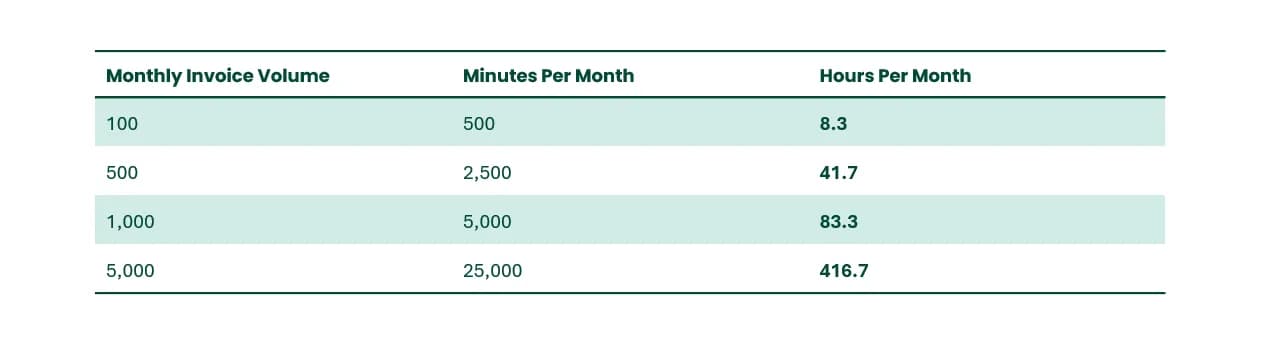
While the widely cited benchmark is approximately 12 minutes per invoice for fully manual processing touch time, the example here uses a modest 5 minutes for simplified calculation to estimate the time cost impact.
At first glance, this seems manageable. A company processing 1,000 invoice per month spends approximately 83 hours every moth on administration alone. At an estimated fully loaded staff cost of S$30 per hour, that’s approximately S$30,000 annually. Many organisations stop their calculation there when they shouldn’t.
The Cost Nobody Measures: Waiting
Most invoices do not spend their time being processed. They spend their time waiting for:
- Department managers
- Budget owners
- Project leaders
- Finance Reviewers
- Senior management approvals
This is where the real inefficiency often occurs. An invoice that takes five minutes to process may spend five days waiting for approval The invoice itself is not the bottleneck but the workflow itself.
A Simple Example
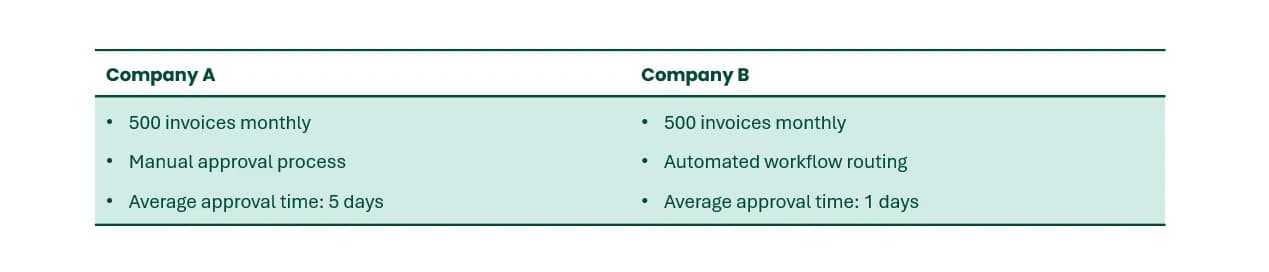
Both companies spend similar amounts of efforts entering invoices, however Company B gains better visibility into liabilities through faster reporting, as well as more predictable cash flow with lower administrative follow-up. The difference isn’t data entry itself but the process design.
The Hidden Cost of Late Approvals
Invoice delays affect more than just finance teams.
- Supplier Relationships: Supplier care less about your internal processes and more about getting paid on time. Repeated payment delays can lead to stricter payment terms, reduced negotiation flexibility or lower supplier confidence. For growing businesses, supplier trust is an operational asset.
- Lost Early Payment Discounts: Many suppliers offer incentive for prompt payment which could be a potential upside for small business owners. Frequent missing that opportunity multiple times each month can turn into a meaningful cost.
- Finance Team Productivity: Every delayed approval creates follow-up work. Finance teams end up sending reminder emails, chasing stakeholders, tracking invoice status or resolving disputes. Time that could be spent on analysis or planning is spend on administration instead.
Why Errors Become More Expensive Over Time
Manual workflows create opportunities for mistakes. Common mistakes such as duplicate payments, incorrect supplier information, wrong expense coding, missing supporting documents, or incorrect payment amounts can happen from time to time. The issue is not the errors happen, but when they are being discovered.
Consider the difference:
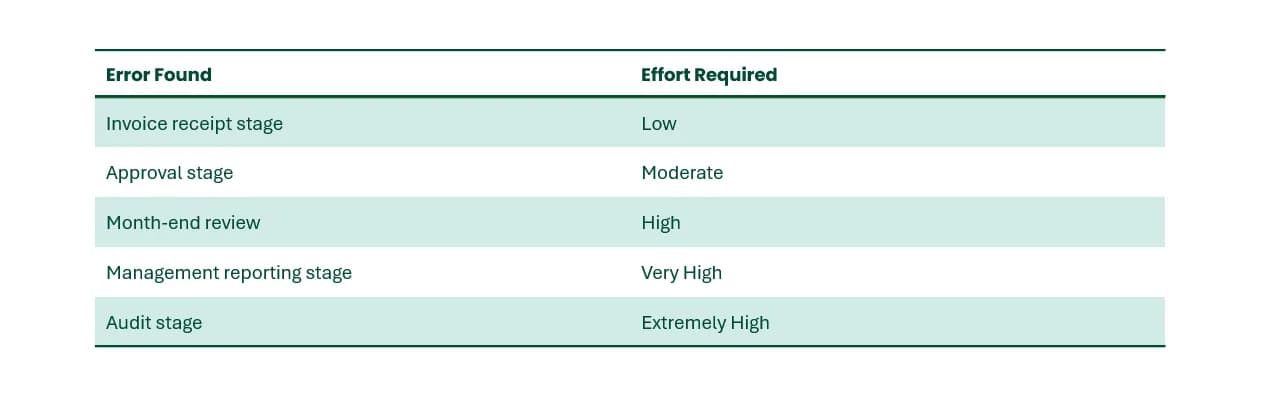
A mistake that takes two minutes to correct today may require hours of investigation a month later. Furthermore, the later an error is discovered, the more expensive it becomes to fix.
The Cash Flow Problem Is Actually a Visibility Problem
Many businesses believe they have cash flow issues; but often, they are visibility issues. When invoices are trapped in inboxes, spreadsheets and approval chains, leaders struggle to answer basic questions:
- How much do we owe supplier?
- What payments are due this month?
- Which departments are overspending?
- What does next month’s cash position look like?
Without timely information, planning becomes reactive rather than proactive. The issue of a lack of cash can be just a disguise of visibility issue.
Why Things Get Worse as Businesses Grow
<p> In many situations, what works at 50 invoices per month rarely works at 500. Manual processes tend to scale in a straight line while operational complexity does not. As business grow, things can move fast:
- More suppliers are added
- More approvers are involved
- More departments incur costs
- More exceptions occur
- More reports are required
At some point, businesses stop scaling operations but begin scaling paperwork. That’s typically the moment leadership starts asking whether a better process exists.
What High-Performing Finance Teams Do Differently
The most efficient finance team do not simply hire more people. They redesign workflows by making improvements at areas such as:
- Automated Invoice Capture: Invoice information is extracted automatically instead of manually entered.
- Workflow-Based Approvals: Invoices are automatically routed to appropriate owner.
- Exception Management: Teams focus only on transactions that require intervention.
- Real-Time Tracking: Anyone involved can see invoices status instantly.
- Integrated Reporting: Invoice data flows directly into reporting and forecasting processes.
By identifying bottlenecks and applying improvement measures, businesses can remove unnecessary frictions.
Five Questions to Ask About Your Invoice Process
- How long does invoice approval actually take?
- How many invoices are overdue waiting for approval?
- Can management see real-time liabilities?
- How often are payment or coding errors discovered?
- Is the process becoming easier or harder as the business grows?
If these questions are difficult to answer, the issues may not simply because of the invoice volume. The issue might lie within the workflow design.
Final Thoughts
Most businesses think invoice processing is an administrative task. In reality, it is a workflow that affects cash flow, supplier relationships, reporting accuracy and operational efficiency. The direct labour cost is usually visible, but the indirect costs are not.
That is why many organizations underestimate the problem until growth begins exposing the weakness in their processes. As business grow, solutions such as NOVA by SimpleAI can help streamline invoice workflows, reduce manual effort and improve visibility across finance and operational processes, allowing teams to focus on higher-value work rather than administrative tasks.
Start a Conversation
Every business operates differently. If you are exploring ways to improve your finance and operational workflows, implement AI practically or prepare your processes for growth, contact SimpleAI to discuss where redesign and automation could create meaningful value.
Frequently Asked Questions
What is invoice processing?
Invoice processing refers to the workflow of receiving, reviewing, approving, recording and paying supplier invoices. It typically involves multiple stakeholders across finance and operational teams.
Can invoice processing be automated?
Yes. Modern accounting, workflow automation and AI tools can automate activities such as invoice capture, data extraction, approval routing, duplicate detection and payment tracking. Human oversight is still important for exceptions and high-risk transactions.
When should a business automate invoice processing?
Businesses should consider automation when invoice volumes are increasing, approval delays are becoming common, finance teams spend significant time on administration, or management lacks visibility into outstanding liabilities and upcoming payments.
Share this article
Related Articles
Continue exploring more insights
 AI & Agentic Transformation
Can AI Replace Accountants? The Wrong Question Businesses Should Be Asking
AI is unlikely to replace accountants, but it will replace much of the administrative work surrounding accounting. Learn how this shift could help finance professionals spend more time on analysis, judgement and business decisions.
SimpleAI
 Finance & Operations
How the Three Financial Statements Connect? (And Why Profit Isn’t Cash)
A business can report rising profits while its cash balance continues to fall. Understanding how the three financial statements connect helps explain where the money went and whether the business is truly financially healthy.
SimpleAI
 Finance & Operations
The Month-End Close: A Step-By-Step Guide for Singapore SMEs
Late reports, missing documents and unresolved discrepancies can make every month-end more difficult than it needs to be. Learn how Singapore SMEs can build a clearer close process, catch errors earlier and gain faster visibility into business performance.
SimpleAI